A fast score can hide a bad state
Drifting asks a small robot to estimate traction, motion, clearance, and route intent at once. A quick lap can still include stale evidence, wall contact, or an unrecoverable pose.
Kairos tests whether a small vehicle can learn drifting behavior from incomplete, mounted-sensor-style evidence while keeping maneuver intent, fast control, recovery, and physical authority in separate layers.
Kairos · decision proof
Read the simulator evidence in one bounded sequence: the motion pressure, the evidence available then, the permission gate, the semantic result, and the retained trace.
Nonlinear simulated motion under changing grip.
Distinct mounted-sensor-style streams and simulator telemetry.
Permission and recovery constraints apply before preference.
A bounded phase and target envelope; fast control stays separate.
Scenario, telemetry, outcome, and retained or rejected learning.
BoundarySimulation evidence only; not physical readiness, actuator authority, autonomous driving, or field deployment.
Drifting asks a small robot to estimate traction, motion, clearance, and route intent at once. A quick lap can still include stale evidence, wall contact, or an unrecoverable pose.
Kairos considers a finite maneuver field, removes ineligible paths, and emits a bounded phase and target envelope. A separate fast controller owns steering and throttle.
Missing evidence remains missing. Faulted outcomes cannot seed a promoted profile. Safety and protected recovery can preempt strategy, and rejected learning intervals are restored.
This continuous 1:53 simulator capture begins with retained learning already present, then shows an in-app learning-state reset from 56/56 to 0/0. The first post-reset run begins around 0:20 and reaches cycle 1/1 around 0:30. Later, the surface and tire compound change while the simulation remains active.
The UI changes from 56/56 retained cycles to 0/0, then shows active drift telemetry and reaches 1/1. This supports an in-app reset sequence; storage erasure, a new process, and the baseline controller's contribution remain unresolved.
Both dropdown changes occur while motion and telemetry update. The capture then continues through 17/17 with no visible pause, crash, rollback, fault, or second reset.
Displayed controlled-drift evidence falls from about 97% before the surface change to roughly 81–82% afterward and 77% after the tire change. In this simulator that reflects fewer signs of deep-angle drift, not a stability score; the vehicle continues without a visible spin, contact, pause, fault, or rollback.
One continuous recording shows an in-app reset from 56/56 to 0/0, post-reset cycle 1/1, two live simulator configuration changes, and continued motion through 17/17.
The learner/controller stack appears to preserve stable, workable drift while adjusting drift depth across both changes in this run. The video does not isolate new learning from baseline heuristic control.
A formal stability metric, repeatability, seed and ordering effects, failure rate, exact reset semantics, causal adaptation, physical equivalence, and actuator authority remain unresolved.
Camera geometry, LiDAR, corner ranging, optical flow, and IMU remain distinct evidence streams. Simulator ground truth is not allowed to masquerade as a live physical observation.
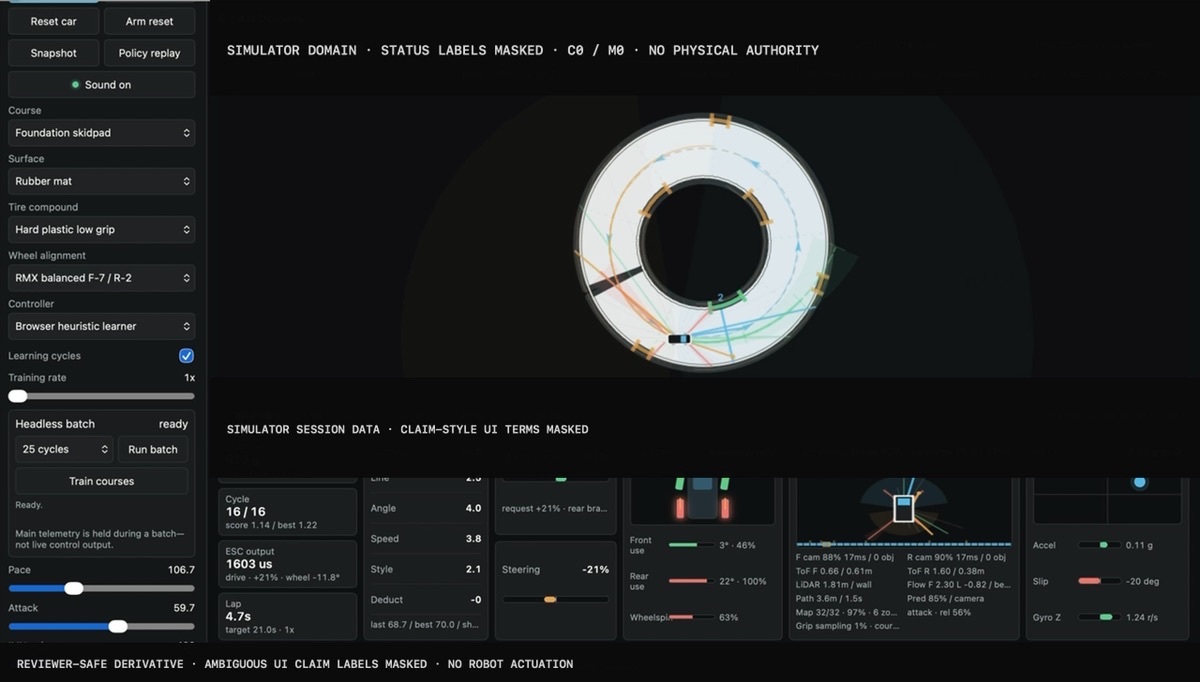
The continuous recording establishes the sequence. These focused panels make the setup, digital domain, and telemetry readable; each is one shown simulator state and does not independently establish change timing, causation, or formal stability.
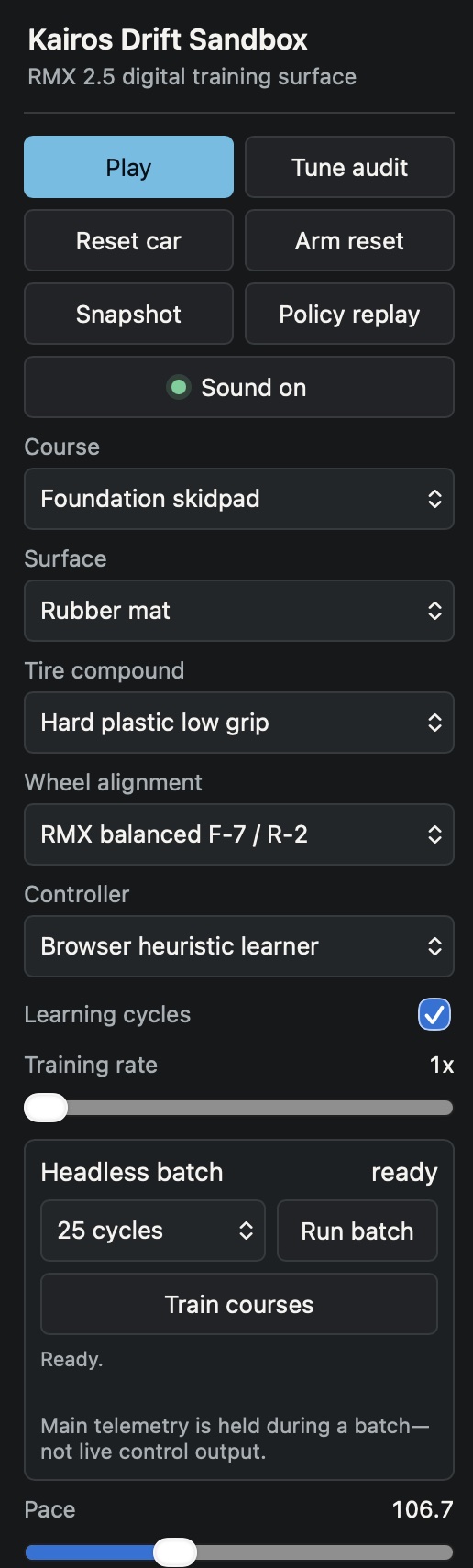
Shown simulator state: Foundation skidpad, Rubber mat, Hard plastic low grip, RMX balanced alignment, and Browser heuristic learner. The recording—not this still—shows when the surface and tire compound change.

This paused, shown simulator state preserves the course and path history. Its status rail is intentionally excluded: in-app license and gate labels govern simulator maneuvers only—not deployment authority or physical actuation.
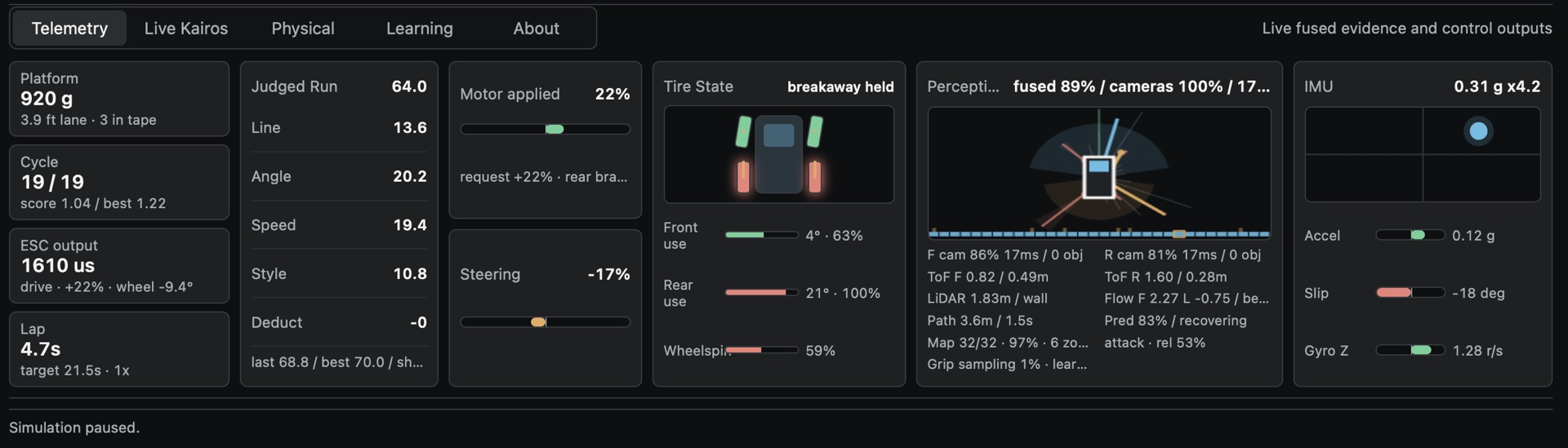
This paused, shown simulator state displays cycle 19/19 beside requested control, tire use, fused perception, and IMU response. The values are session telemetry, not an external benchmark or evidence of physical actuation.
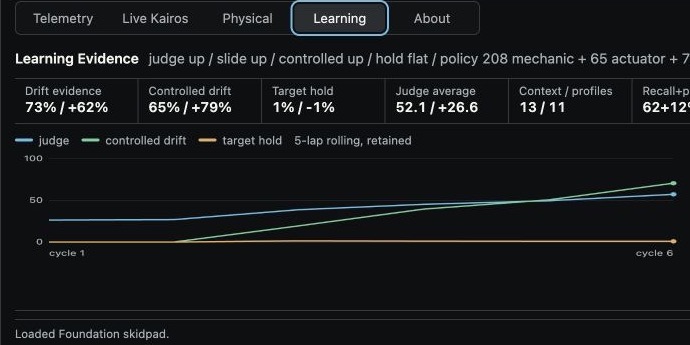
Judge, controlled drift, and target hold remain separate across the retained window. That makes plateaus, contradictions, and reward shortcuts visible instead of compressing every outcome into one score.
Freshness and confidence remain attached to each sensor role.
Build, initiate, catch, sustain, transition, settle, or recover.
A score cannot compensate for a failed hard condition.
Strategy proposes a phase goal—not direct actuator output.
Fast control and recovery keep downstream authority.
Only complete, valid outcomes may shape retained memory.
The sandbox retains judge, controlled-drift, target-hold, fault, context, prediction, and rollback evidence separately. More cycles do not automatically become improvement.
Judge average 55.5 · phase coverage 75% · settle phase absent. One tracked replay with a visible gap—not a current benchmark.
Kairos’s proof is the separation: perception, intent, control, safety, outcome, and learning remain reconstructable layers.
Kairos remains at the C0 / M0 authority ceiling. The material shown here is simulation evidence only; it does not establish semantic or implementation conformance, trace demonstration, physical equivalence, autonomous drifting, deployment readiness, or permission to actuate the robot.
The simulator and live-monitor views expose no implicit hardware command path. Physical familiarization remains a separately gated, supervised commissioning domain.